Most large organizations have spent serious money on leadership development. The programs look good on paper, the facilitators are credentialed, and the post-session surveys are positive. Then six months later, nothing has changed. And nobody can explain exactly why.
The problem isn’t the content. It’s the architecture.
Direct Answer
Leadership development fails in large organizations because it treats leadership as a skill to be learned in isolation rather than a behavior that has to be reinforced by the systems around it. Programs teach the right things but leave the organizational conditions, incentive structures, managerial modeling, promotion criteria, completely untouched. Until those conditions change, the training doesn’t stick.
Key Takeaways
- Leadership programs fail not because the content is wrong, but because the organizational environment contradicts what they teach
- Promotion decisions are the most powerful signal in any culture. Who gets promoted tells your people what leadership actually means at your company
- The gap between stated leadership values and observed leadership behavior is where culture lives and dies
- High-potential leaders need structural reinforcement, not just skill-building, to transfer learning into daily practice
- The cost of doing nothing compounds: disengaged managers don’t just underperform. They actively suppress the performance of everyone around them
Why Do So Many Leadership Programs Produce No Lasting Change?
Here’s the real answer: most leadership development is designed for individual transformation inside a system that was built to resist it.
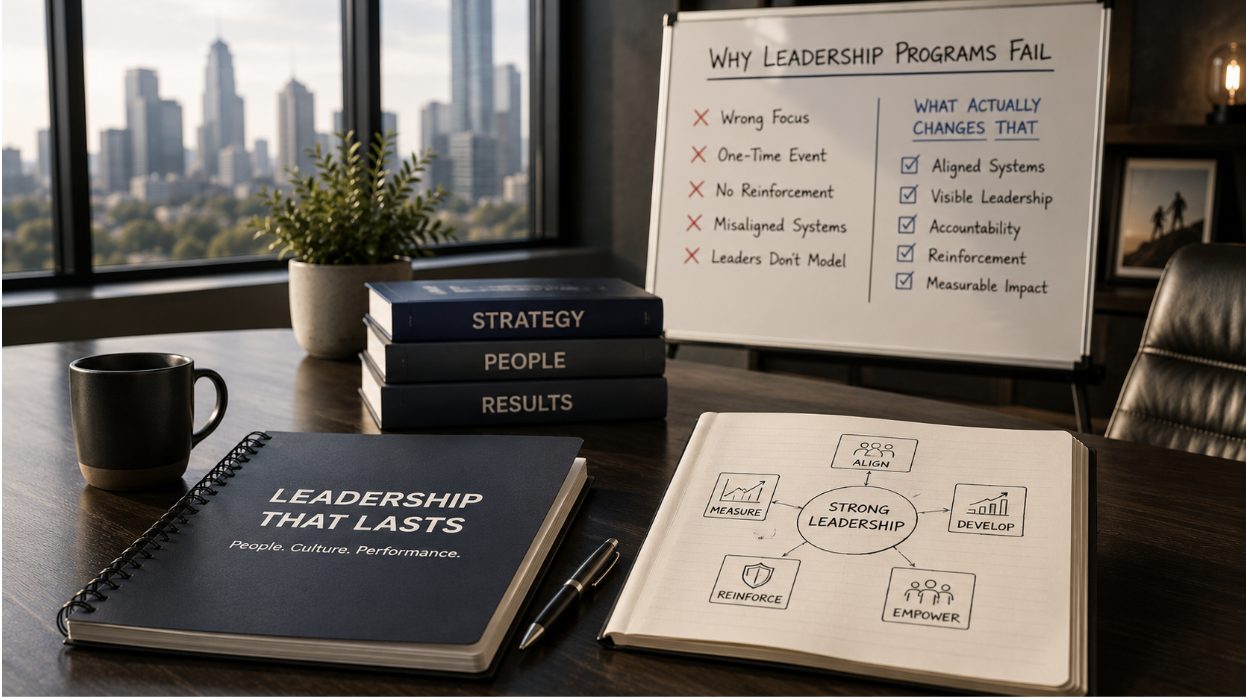
A typical program pulls high-potential leaders out of their daily environment for two or three days of intensive training. They learn frameworks for feedback, coaching, delegation, and influence. The content is solid. The instructors are good. Then participants go back to their desks, their same managers, their same performance metrics, and their same unwritten rules about what actually gets rewarded.
The training was real. The environment is louder.
The mechanism matters here. Behavior change requires three things operating simultaneously: new knowledge, a reason to apply it, and a safe environment to practice it. Most programs deliver the first. Almost none address the second or third. That’s not a content problem. It’s a design problem.
McKinsey research on organizational health consistently shows that companies in the top quartile of organizational health outperform their peers on long-term financial returns. The differentiator isn’t the quality of their training programs. It’s the coherence between what leaders are taught and what the organization actually rewards.
What’s the Real Root Cause. And Why Does It Persist?
The root cause is what you could call the Credibility Gap: the visible distance between what an organization says leadership looks like and what it actually promotes, tolerates, and celebrates.
The Credibility Gap is the measurable distance between a company’s stated leadership values and the observable behavior of its most senior leaders.
When employees see a manager who consistently takes credit for team wins, dismisses direct reports in meetings, and never develops anyone, and that manager keeps getting promoted, the message is unmistakable. No training program can compete with that signal. The organization has already told people what leadership really means.
This is why the gap persists even in organizations that genuinely care about culture. The people designing the programs are often not the same people making promotion decisions. And the people making promotion decisions are often rewarding the behaviors that got them to the top. Which may or may not reflect the values in the leadership competency model.
You can read more about the patterns behind this in Steve Degnan’s analysis of engagement challenges organizations face year after year. The structural causes haven’t changed much, but most organizations keep treating them as surprises.
What Does Effective Leadership Development Actually Look Like?
The organizations that get this right don’t just run better programs. They change what surrounds the programs.
Consider a common scenario: a Fortune 500 business unit launches a high-potential leadership cohort. The content is excellent – 360 feedback, executive coaching, action-learning projects. But the unit’s senior VP still runs every decision through himself, still rewards individual heroics over team outcomes, and still promotes based on technical results rather than people development. Twelve months later, most of the cohort’s behavioral gains have eroded. Not because the participants weren’t motivated. Because the environment sent a different message every single day.
Contrast that with a unit where the same program is paired with three structural changes: promotion criteria that explicitly weight people development, senior leaders who visibly model the target behaviors, and managers who are held accountable for the growth of their direct reports. The training content doesn’t have to be better. The environment is doing the reinforcement work.
The most expensive leadership development mistake isn’t a bad program. It’s a good program inside a system that punishes what it teaches.
This is where Steve Degnan’s advisory work operates differently. With 32 years of corporate experience, including 20 years as CHRO of a $13B organization, the approach isn’t to design another workshop. It’s to diagnose the gap between what an organization says it values and what its systems actually reward, then build the structural reinforcement that makes training investment stick.
The Promotability Signal: Why Promotion Decisions Are Your Real Culture Document
Here’s the contrarian claim worth sitting with: your leadership competency model is not your culture. Your last ten promotion decisions are.
Every time you promote someone, you’re publishing a policy. Everyone in the organization reads it. They adjust their behavior accordingly. Not based on what’s in the model, but based on what they observed in the person who got the job.
This is why Steve Degnan’s work on what makes leaders genuinely promotable and resilient goes beyond skill inventories. The question isn’t just “what does this person know?” It’s “what does promoting this person tell everyone else about what we value?”
If your last three promotions went to leaders who hit their numbers but burned through their teams, you’ve told your organization that results justify the cost. No amount of training on psychological safety will undo that message.
Comparing Approaches: What Separates Programs That Work from Ones That Don’t
| Dimension | Isolated Training Programs | Structurally Integrated Development |
| Focus | Individual skill-building | Individual skills + environmental reinforcement |
| Duration | Event-based (1-3 days) | Ongoing, embedded in workflow |
| Accountability | Participant self-report | Manager accountability + promotion criteria |
| Senior leader role | Sponsor or kickoff speaker | Active model of target behaviors |
| Measurement | Satisfaction scores | Behavioral observation + business outcomes |
| Culture impact | Minimal. Environment unchanged | High. Signals and systems aligned |
| Risk of regression | High within 6 months | Lower when structural changes hold |
The difference isn’t budget. Organizations spend heavily on isolated programs and get minimal return. The organizations that see lasting change spend the same money but deploy it differently. Earlier in the diagnostic phase and deeper into the system design.
What This Approach Doesn’t Fix. And When It’s the Wrong Conversation
Structural leadership development doesn’t solve a performance problem caused by the wrong people in the wrong roles. If the issue is a fundamentally misaligned executive team or a CEO whose behavior contradicts every stated value, no program architecture fixes that. That’s a people decision, not a development question.
This work also takes time. Behavioral change at the organizational level is typically an 18-to-24-month arc when done honestly. Anyone promising a 90-day culture transformation is selling you something that doesn’t exist.
And if your organization is in active crisis, restructuring, significant workforce reduction, or leadership transition, the conditions for sustained development work aren’t present yet. In those situations, the immediate priority is stability and clear communication, not competency frameworks. Steve Degnan’s guidance on navigating layoffs and workforce transitions addresses what leaders actually need in those moments.
The goal here isn’t to tell you development work is always the answer. It’s to make sure that when you invest in it, you’re not pouring it into a system designed to drain it.
FAQ
Why does leadership training seem to work right after the program but fade within a few months? The training changes what people know, but it doesn’t change the environment they return to. When the daily incentives, managerial behavior, and promotion signals stay the same, the new behaviors have no reinforcement. And the old ones have plenty. Retention requires structural support, not just good content.
How do we know if our leadership development problem is a program problem or a culture problem? Look at your last ten promotions. If the people who advanced don’t reflect the leadership values you say you’re building, you have a culture problem that a better program won’t fix. The diagnostic question is always: what does this organization actually reward?
What’s the right starting point for a large organization trying to fix this? Start with an honest audit of the gap between stated leadership values and observed leadership behavior at the senior level. That gap tells you more about your development priorities than any competency model. Most organizations skip this step because the findings are uncomfortable.
Can a single business unit fix this without enterprise-wide change? Yes. And it’s often where the most durable change starts. A business unit that aligns its own promotion criteria, managerial modeling, and development investment can build a culture that outperforms the rest of the organization. It also creates a visible proof point that accelerates broader adoption.
How do you measure whether leadership development is actually working? Not through satisfaction surveys. Measure behavioral change through structured observation, 360 feedback over time, and, most importantly, whether the people who complete development programs are getting promoted and retaining their teams. If the answer to both is yes, the program is working.
Is executive coaching a substitute for structural development work? No. And conflating the two is a common and expensive mistake. Executive coaching develops an individual. Structural development work changes the conditions that shape how all leaders behave. You need both, but coaching alone doesn’t move the organizational needle.
How long does it realistically take to see culture change from this kind of work? Honest answer: 18 to 24 months for meaningful, observable change at the organizational level. You’ll see early signals, different conversations, different promotion decisions, different team behavior, within six to nine months if the structural changes are real. Anyone promising faster results is describing something shallower.
If You’re Sitting With This Article Right Now
You probably already know which programs in your organization are producing real change and which ones are producing good survey scores. The harder question is whether you have the diagnostic clarity and the organizational will to address what’s actually causing the gap.
That’s the conversation Steve Degnan’s advisory work is built for. If you’re ready to move from program design to system design, to build the structural conditions that make leadership development stick, reach out directly to start that conversation.
About the Author
Steve Degnan – Pragmatic Leadership Keynotes & Advisory is an executive consulting and keynote speaking practice specializing in leadership development, organizational culture, and team resilience. Drawing on 32 years of corporate experience, including 20 years as CHRO of a $13B company, Steve Degnan works with Fortune 500 companies, business units in transformation, and senior leadership teams to build the structural conditions that produce promotable, resilient leaders and lasting cultural change.
References
McKinsey & Company. Organizational Health Index and long-term performance research